
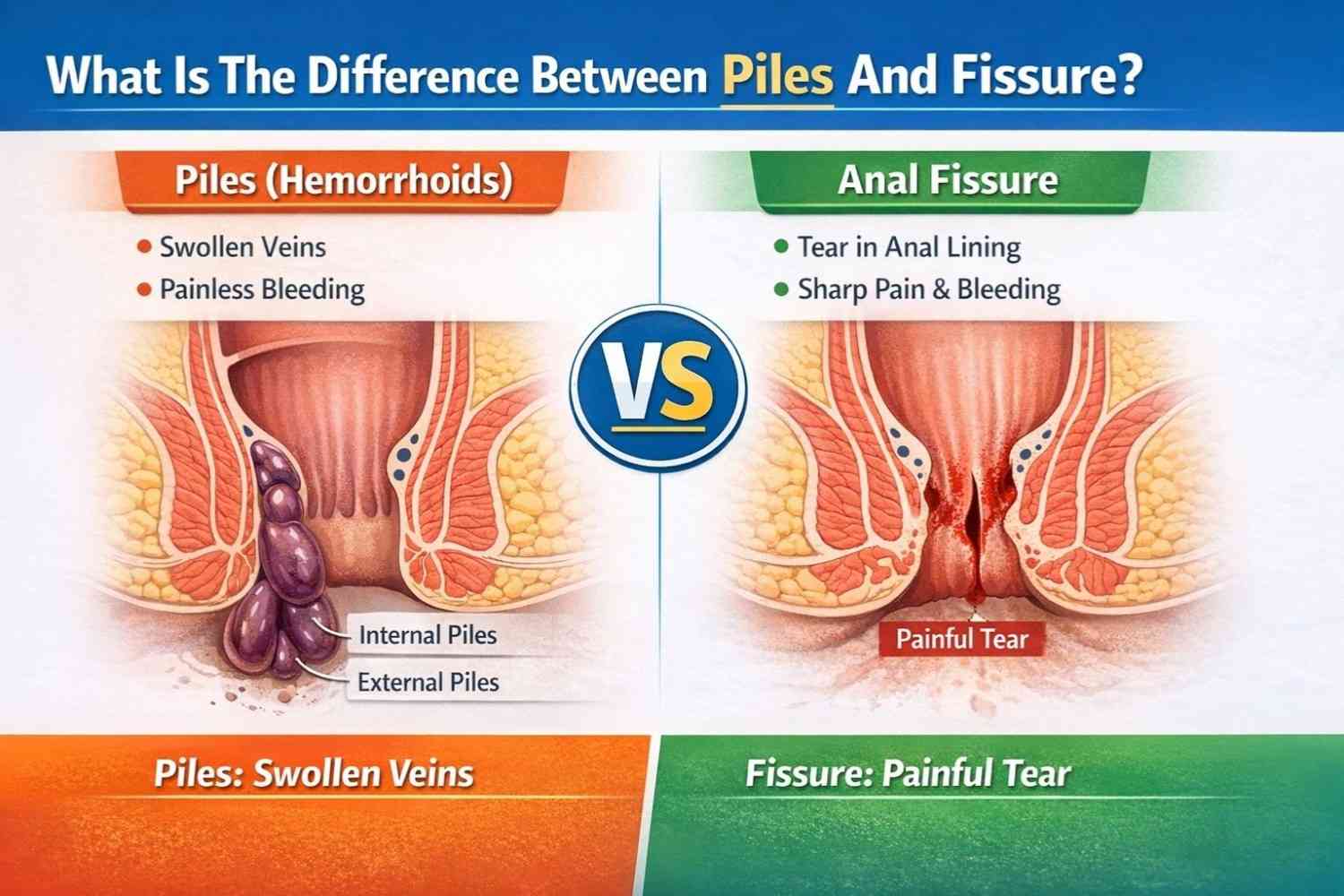
What Is The Difference Between Piles And Fissure?
Difference Between Piles And Fissure
If you have ever searched “what is the difference between piles and fissures”, you are not alone. Many people confuse these two painful anal conditions. They share similar symptoms, they affect the same area, and yes, they can both ruin your day.
As a clinic that regularly consults with the Best Piles Doctor in Delhi, we often hear patients say, “Doctor, I think I have piles… or maybe fissure?” That confusion is common. This guide will clearly explain the piles vs fissure difference, using trusted medical sources and clinical understanding from institutions like the Mayo Clinic and Cleveland Clinic.
Let’s break it down in simple, human language.
Understanding the Basics: Piles vs Fissure
Before we compare, let’s define both conditions properly.
What Are Piles?
Piles, also called hemorrhoids, are swollen veins in the lower rectum or anus. According to the Mayo Clinic, hemorrhoids develop due to increased pressure in the lower rectum, often from constipation, straining, pregnancy, or prolonged sitting.
They can be:
Internal piles (inside the rectum)
External piles (under the skin around the anus)
This is why people often search for internal piles vs fissure or external piles vs fissure when trying to identify their symptoms.
What Is an Anal Fissure?
An anal fissure is a small tear in the lining of the anus. The American Society of Colon and Rectal Surgeons (ASCRS) explains that fissures usually happen due to passing hard stool or repeated constipation.
Unlike a pile, a fissure is not a swollen vein. It is a cut. And cuts hurt. A lot.
Also Read: What are the Different Types of Piles? A Complete Guide to Symptoms, Grades, and Treatment Options
Pile vs Fissure Difference: Side-by-Side Comparison
Let’s get straight to the point. Here is the real difference between piles and fissure explained clearly.
Cause
Piles: Caused by swollen veins due to pressure.
Fissure: Caused by a tear in the anal lining.
Think of piles as varicose veins. Think of fissure as a paper cut in a very sensitive place.
Pain Pattern
One of the biggest differences lies in pain.
Fissure Pain
- Sharp, cutting pain during bowel movement.
- Pain may last for minutes or even hours after passing stool.
- Many patients describe it as “passing glass.”
Piles Pain
- Internal piles often cause painless bleeding.
- External piles may cause discomfort or swelling.
- Severe pain usually happens only if a clot forms (thrombosed hemorrhoid).
This explains the common search query: difference between piles and fissure pain. Fissure pain is typically sharper and more intense.
Also Read: Constipation vs Piles: Symptoms, Causes, Differences & Treatment Guide
Bleeding Pattern (Piles vs Fissure Symptoms)
Both can cause bleeding, which adds to confusion.
Piles bleeding: Bright red blood, usually painless.
Fissure bleeding: Small streaks of blood, often with severe pain.
According to the Cleveland Clinic, fissures almost always cause pain during bowel movements, while many hemorrhoids do not.
Visible Signs
People often ask about skin tag piles vs fissure.
Chronic fissures can develop a small skin tag called a sentinel tag.
External piles may look like swollen lumps around the anus.
This visual similarity often confuses patients. A proper physical examination by a specialist clears the doubt quickly.
Internal Piles vs Fissure: How to Tell the Difference
Internal piles remain inside the rectum and may not cause pain. You might only notice bleeding.
Fissures, on the other hand, almost always cause severe pain.
If your main complaint is bleeding without pain, piles are more likely. If your main complaint is sharp pain with stool, fissure is more likely.
Still unsure? A consultation with the Best Piles Doctor in Delhi can confirm the diagnosis within minutes.
Chronic Piles vs Fissure: When Problems Become Long-Term
Both conditions can become chronic.
Chronic Piles
Persistent swelling
Recurrent bleeding
Prolapse (coming out during stool)
Chronic Fissure
Tear does not heal within 6 weeks
Muscle spasm in anal sphincter
Severe ongoing pain
ASCRS guidelines show that chronic fissures may require advanced treatment if ointments fail.
This leads to another common question:
Fissure vs Piles: Which Is More Dangerous?
In most cases, neither condition is life-threatening. However:
Chronic bleeding from piles may lead to anemia.
Chronic fissures can cause intense pain and infection.
Both need proper treatment. Ignoring them makes recovery harder.
Hemorrhoids vs Anal Fissure: Why Self-Diagnosis Fails
Many patients use over-the-counter creams without knowing the actual problem.
Here’s the issue:
Hemorrhoid creams may not heal a fissure.
Fissure ointments may not shrink piles.
That is why understanding the piles vs fissure difference matters. Treatment depends on correct diagnosis.
If you search online for a reliable clinic, you can locate Centre For Piles & Fistula on Google My Business. Patients often prefer clinics where diagnosis includes proper examination instead of guesswork.
Difference Between Piles and Fissure Symptoms (Detailed Breakdown)
Let’s simplify it further.
Symptoms of Piles
Painless bleeding (common in internal piles)
Swelling near the anus
Itching
Lump sensation
Mucus discharge in some cases
Symptoms of Fissure
Sharp pain during bowel movement
Burning sensation
Visible tear
Spasm feeling
Fear of passing stool
This explains the common search: the difference between piles and fissure symptoms.
Fissure and Piles Treatment: Evidence-Based Options
According to Mayo Clinic and ASCRS guidelines, treatment depends on severity.
Treatment for Piles
High-fibre diet (25–35 grams daily as recommended by medical authorities)
Increased water intake
Sitz bath
Topical creams
Rubber band ligation
Laser or surgical options for severe cases
Treatment for Fissure
Stool softeners
Fiber intake
Warm sitz baths
Topical nitroglycerin or calcium channel blockers (prescribed)
Botox injection in chronic cases
Lateral internal sphincterotomy in severe cases
A trained specialist ensures safe management. Many women also prefer consulting a female doctor for a fissure in Delhi for comfort and privacy.
External Piles vs Fissure: Quick Clinical Clue
If you feel a painful swelling outside the anus, it could be external piles.
If you feel cutting pain without a visible lump, a fissure is more likely.
Still, only a clinical exam confirms it. Avoid guessing.
Why Early Consultation Matters
Here’s some logic. If your car makes noise, you do not replace random parts. You get it checked. Your body deserves the same respect.
Untreated piles may lead to:
Persistent bleeding
Clot formation
Prolapse
An untreated fissure may lead to:
Severe muscle spasm
Chronic tear
Recurrent pain cycle
Consulting the Best Piles Doctor in Delhi early can prevent complications and reduce treatment cost.
Lifestyle Changes That Help Both Conditions
Science supports lifestyle modification as first-line treatment.
Increase fibre intake
Drink 2–3 litres of water daily
Avoid prolonged sitting
Do not strain during bowel movements
Exercise regularly
The National Institute of Diabetes and Digestive and Kidney Diseases (NIDDK) supports dietary fibre as key prevention for hemorrhoids and fissures.
When Should You See a Doctor Immediately?
Seek medical advice if you notice:
Heavy bleeding
Black stool
Severe pain lasting hours
Fever
Recurrent symptoms
These signs require medical evaluation to rule out other serious conditions.
What Is Difference Between Piles and Fissure? Final Summary
Let’s wrap it up clearly.
So, when someone asks, “what is the difference between piles and fissure?”, the simplest answer is:
Piles are swollen veins. Fissure is a cut.
And yes, that small difference changes everything about pain and treatment.
Expert Summary: Piles vs Fissure – What You Should Remember
Many people delay treatment due to embarrassment. That delay often makes the condition worse.
If you notice symptoms and feel unsure about piles vs fissure symptoms, get evaluated. A qualified specialist or a female doctor for fissure in Delhi can provide comfortable consultation options.
You can also locate trusted centers like Centre For Piles & Fistula through Google search to explore professional care options.
Your body gives signals for a reason. Listen early. Treat early. Heal faster.
Recent Blogs
Prunes vs. Prune Juice for Constipation: Whic...
12 Oct 2026
Can Chia Seeds Relieve Constipation? Benefits...
09 Oct 2026
Piles Myths and Facts: What You Should Really...
14 Sep 2026